The Day Of The Dead
This article was sent to me by a friend.
More than 500 years ago, when the Spanish Conquistadors landed in what is now Mexico, they encountered natives practicing a ritual that seemed to mock the death. It was a ritual the indigenous people had been practicing at least 3,000 years. A ritual the Spaniards would try unsuccessfully to eradicate.
Regions in the states of Oaxaca, México, and Michoacán have special traditions to commemorate the Day of the Dead. A visit to these states during the celebration becomes an unforgettable experience. In Nejapa de Madero, Oaxaca, preparations begin as earky as a month before when the stalks are chosen for the family altars, typical foods are slowly prepared, and mezcal is bought.
On November 1, people adorn the graves of their "little angels" (angelitos), those who died as children. Church bells begin their two-day and night tolling. On November 2, people gather to hear priests give sermons for the souls of the deceased, while bands play traditional music. People search the neighborhood for the souls of relatives who cannot find their way home. They visit neighbors' houses saying: "Will you give me a dead soul?" If the neighbor is just an acquaintance, he/she says to them: "proceed to the altar to pray", after which they are given something from the altar. If the neighbor is a friend, they are shown to the dining room where they are given mezcal, an alcoholic drink, and food. One must have a big appetite and a high alcohol tolerance level, because one eats and drinks at every house visited. In Metepec, bells announce the arrival of the souls of both children and adults. People dress in black during the entire celebration, and families recite the 9th psalm and burn copal and incense. In addition, a great variety of famous ceramic ware is produced during this celebration.
Tradition has it that children's souls arrive on November 1 at 8 a.m. Upon their arrival, they are served with a breakfast consisting of arroz con leche (rice pudding), chocolate, pumpkin seed candies, almond sugar dough and bread. At 8 p.m., the adult souls are believed to return. The offering to them consists mainly of tamales of three different colors (made from three different types of corn), a plate of mole with the soul's favorite chicken piece, camotes, chayotes, pulque, water, raspberry wine, guayaba or lemon, etc. A common practice is for people to put pictures of the dead soul and its saints with the offerings in order to be protected by them. While the children's souls leave at 12 noon on the same day (November 1), the adults are said to leave at 2 p.m. on the following day (November 2).
In Janitzio island, in the state of Michoacán, November 1st represents a day of great feasting. At midnight, the rituals spread out around Lake Pátzcuaro which surrounds the island, and soon the tolling of church bells begins. At this point, it is believed that the souls return to cemeteries everywhere. People bring them offerings of flowers, lights and foods such as bread, candy, fruit, etc. to the graves. Altars are set up on the graves, and everyone prays by candlelight. All night long the bells continue to toll calling for the dead to return for the ceremony. Throughout the island, people use candles, songs and music to plead for their absent souls' rest.
Saturday, October 27, 2007

Friday, September 28, 2007


Saturday, August 25, 2007
Wicca

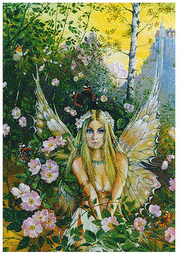
" Wicca is a forest in the light of the silvery moon...
a glade enchanted by the light of the Faery.
It is the dewdrop on the petals of a flower in bloom,
the warmth of the summer sun on the skin,
the fall of colourful autumn leaves,
and the softness of winter snow upon the Earth.
It is light, and shadow and all that lies in between.
It is the song of the wind, and the tune of the tides.
It is the symphony of life!
Author unknown
Wednesday, July 18, 2007
Kitchen Witch's ABC
Always stir in a clockwise motion.
Before you chop veggies, offer thanks.
Cut mindfully, gratefully.
Do all preparations in a loving spirit.
Energize food with good thoughts.
Feast gratefully.
Give & share what you can spare.
Home & hearth are sacred.
Invoke blessings of Goddess on all food.
Join hands with friends often.
Kindness shows in serving food.
Love goes into every dish.
Mindfully gather ingredients.
No wasting - recycle, compost, feed animals.
Open your senses, enjoy your surroundings.
Play as well as work.
Quench thirst, thinking of clear clean rivers.
Resolve to be grateful & waste not.
Salivate as you smell fragrance & anticipate flavors.
Thank the Universe & Goddess for health.
Use utensils carefully, then clean up.
Value time spent with loved ones.
When possible grow & harvest your food.
Xtra food is for creative recombining.
Yearly rituals & feasts build traditions.
Zestful living in every area is our goal.
Source Unknown
Before you chop veggies, offer thanks.
Cut mindfully, gratefully.
Do all preparations in a loving spirit.
Energize food with good thoughts.
Feast gratefully.
Give & share what you can spare.
Home & hearth are sacred.
Invoke blessings of Goddess on all food.
Join hands with friends often.
Kindness shows in serving food.
Love goes into every dish.
Mindfully gather ingredients.
No wasting - recycle, compost, feed animals.
Open your senses, enjoy your surroundings.
Play as well as work.
Quench thirst, thinking of clear clean rivers.
Resolve to be grateful & waste not.
Salivate as you smell fragrance & anticipate flavors.
Thank the Universe & Goddess for health.
Use utensils carefully, then clean up.
Value time spent with loved ones.
When possible grow & harvest your food.
Xtra food is for creative recombining.
Yearly rituals & feasts build traditions.
Zestful living in every area is our goal.
Source Unknown
Saturday, June 30, 2007
Blue Moon
The second full moon in a month has just the same color as always. It does not turn blue at all. So why do people call this a blue moon? Can the moon really turn blue? There are several definitions of 'blue moon'.
1. Four hundred years ago, if someone said, "He would argue the moon was blue," it would be understood as, "He'd argue that black is white."
2. Also long ago, 'blue moon' was synonym for 'absurd'. "When the moon turns blue", would be similar to the expression "when pigs fly". It was so absurd that it would never happen.
3. In astronomy, we have a blue moon when certain types of dust and smoke from volcanoes or forest fires absorb red light. When this happens, the moon and the sun get a blue tint. This however is a very rare phenomenon. It happened in 1883 when the Indonesian volcano Krakatoa exploded, in 1927 when a late monsoon in India set up conditions for a blue moon and in 1951 when huge forest fires in Alberta threw smoke particles up into the sky.
4. The phrase "once in a blue moon" means, that an event is fairly infrequent, but not quite regular enough to pinpoint.
5. There are popular songs in which "blue moon" is a symbol of sadness and loneliness.
6. In recent years, the less scientific, but more popular definition of the blue moon has become widespread, namely that it is the second full moon within one month.
So which version is correct?
Officially, the third definition, the astronomical one, is correct. The sixth definition, the two full moons in one month variety, may appeal to many people, but has no roots in folklore. But as this popular definition is now so widely used, it doesn't make sense to ignore it in favour of the astronomical description. When people claim that the 'second full moon' definition is wrong, then they are technically correct. Language is a dynamic medium however. So when enough people use a false expression, it will in time become correct. Therefore, at this moment, it is not more than logical to state that a 'blue moon' is a rare astronomical phenomenon, but also an occurence of two full moons within one month.
This article was based on: "The rising of the bogus blue moon" - Terence Dickinson "Folklore of the 'Blue Moon'" - Philip Hiscock
1. Four hundred years ago, if someone said, "He would argue the moon was blue," it would be understood as, "He'd argue that black is white."
2. Also long ago, 'blue moon' was synonym for 'absurd'. "When the moon turns blue", would be similar to the expression "when pigs fly". It was so absurd that it would never happen.
3. In astronomy, we have a blue moon when certain types of dust and smoke from volcanoes or forest fires absorb red light. When this happens, the moon and the sun get a blue tint. This however is a very rare phenomenon. It happened in 1883 when the Indonesian volcano Krakatoa exploded, in 1927 when a late monsoon in India set up conditions for a blue moon and in 1951 when huge forest fires in Alberta threw smoke particles up into the sky.
4. The phrase "once in a blue moon" means, that an event is fairly infrequent, but not quite regular enough to pinpoint.
5. There are popular songs in which "blue moon" is a symbol of sadness and loneliness.
6. In recent years, the less scientific, but more popular definition of the blue moon has become widespread, namely that it is the second full moon within one month.
This new meaning has mainly become popular through the Trivial Pursuit game in 1986. Ever since this definition has been the most widely used.
So which version is correct?
Officially, the third definition, the astronomical one, is correct. The sixth definition, the two full moons in one month variety, may appeal to many people, but has no roots in folklore. But as this popular definition is now so widely used, it doesn't make sense to ignore it in favour of the astronomical description. When people claim that the 'second full moon' definition is wrong, then they are technically correct. Language is a dynamic medium however. So when enough people use a false expression, it will in time become correct. Therefore, at this moment, it is not more than logical to state that a 'blue moon' is a rare astronomical phenomenon, but also an occurence of two full moons within one month.
This article was based on: "The rising of the bogus blue moon" - Terence Dickinson "Folklore of the 'Blue Moon'" - Philip Hiscock
Wednesday, June 20, 2007
Making A Besom

Making A Besom
choice's of woods, for your handle.
Ash (protection, prosperity, health)
Ash (protection, prosperity, health)
Birch (protection, binding, purification)
Dogwood (wishes, protection)
Dogwood (wishes, protection)
Elder (binding, protection, healing)
Oak (protection, health, money, healing)
Pine (healing, protection, binding, money)
If you decide to put a finish on the handle
strip the wood first then let it dry, it may need same
sanding.The next step is gathering the materials
for the "broomstraws" the binding and
any decorative touches you may want too add.
Straw is easily obtained and can be dyed using
for the "broomstraws" the binding and
any decorative touches you may want too add.
Straw is easily obtained and can be dyed using
herbal color, fairies love straw. Wheat can also be used,
how ever it could shed more than you wish.
how ever it could shed more than you wish.
Traditional binding for a magical, broom is a
Willow branch. The willow is flexible and easy
to work with. Binding the straw
(Soak your straw, work with it damp)
use a double binding method for this. Before cutting the
(Soak your straw, work with it damp)
use a double binding method for this. Before cutting the
straw the length you prefer add two inches to make
up for the binding. Gather the straw with the ends
even and pointing towards the top if the
even and pointing towards the top if the
handle, distributed aroundyour handle, bind the
added two inches with strong twine, fold the
straw down pointing in the right direction and
bindwith the Willow branch.
Personal touches
Make the Besom uniquely your own.Use your
Make the Besom uniquely your own.Use your
imagination and have fun creating!!
Sunday, June 3, 2007
The Moon Is Full Tonight

Cool is the night and worm is my
hart, that I give to thy
This poem’s author is un-knownThe Moon takes me in her arms and carries me
away to the land of the Witches.
To Be A Witch
To be a witch, is to love and be loved.
To be a witch is to know everything and to know nothing at all.
To be a witch is to change the world around you and yourself.
To be a witch is to share and give, and to hold hands with the universe.
To be a witch is to honor the Gods, and yourself.
To be a witch is to BE magick, not just perform it.
To be a witch is to be honorable, or be nothing at all.
To be a witch is to be accepting of others who are not.
To be a witch is to know that what you feel is right and good.
To be a witch is to BE magick, not just perform it.
To be a witch is to be honorable, or be nothing at all.
To be a witch is to be accepting of others who are not.
To be a witch is to know that what you feel is right and good.
To be a witch is to harm none.
To be a witch is to know the ways of old.
To be a witch is to see beyond the barriers.
To be a witch is to follow the moon.
To be a witch is to be one with the Gods.
To be a witch is to study and learn.
To be a witch is to be the teacher and the student.
To be a witch is to acknowledge the truth.
To be a witch is to live with the Earth, not just in it.
To be a witch is to be truly free.
To be a witch is to know the ways of old.
To be a witch is to see beyond the barriers.
To be a witch is to follow the moon.
To be a witch is to be one with the Gods.
To be a witch is to study and learn.
To be a witch is to be the teacher and the student.
To be a witch is to acknowledge the truth.
To be a witch is to live with the Earth, not just in it.
To be a witch is to be truly free.
Subscribe to:
Posts (Atom)